Prepaid Deposits and the Casinos That Take Them
A prepaid voucher is the only deposit method that costs more the less you use it, cannot be reversed, and cannot carry a withdrawal home. Players who use one know all three things and choose it anyway.
This site prices bonuses, not payment methods. But the same habit applies: read what the provider publishes, quote the figure it publishes, and say plainly where a number stops being knowable. What follows is the published side of prepaid deposits, with the parts nobody advertises.
What a prepaid deposit actually is
A voucher bought for cash at a retail counter, carrying a PIN and a balance. You spend the balance by entering the code at a casino cashier. Nothing about your bank account or card reaches the operator, because there is nothing to send: the money left your hands at the shop. In the US the product is a closed-loop gift card ticket issued by The Bancorp Bank N.A., a member of the FDIC, which is the detail that decides what protections apply to it.
That structure explains every other property of the instrument. The balance is finite and fixed at purchase. There is no chargeback, because no card network was involved. And there is no return path, because a shop counter cannot receive a payout.
The fee is charged before the casino sees the money
Every voucher carries a distributor fee, and it is flat rather than proportional, which makes small denominations expensive in percentage terms.
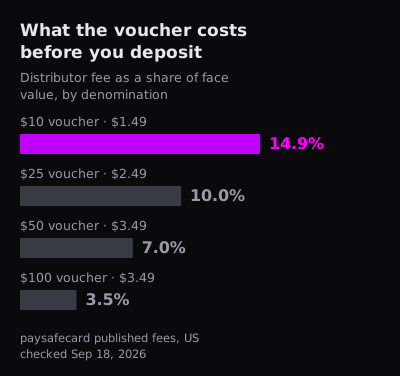
A $10 voucher costs $1.49, or 14.9% of face value. A $100 voucher costs $3.49, or 3.5%. The fee is identical in dollars at $50 and $100, so a player who buys two $50 vouchers instead of one $100 pays twice for the same money. Buying directly from the issuer’s own PIN shop carries no convenience fee, which is the cheapest published route.
It is the same arithmetic the register applies to bonus terms on our method page: a headline figure, a cost that is published but not displayed next to it, and a real number that only appears when you subtract one from the other. A 14.9% entry fee is not a rounding error on a small bankroll.
The published ceilings
The voucher is capped by design. paysafecard publishes a maximum combined PIN transaction of $300. The account version of the product holds up to $1,000 in PINs and permits $1,000 of PIN value to be used per month. There is also a $2 monthly administration fee that begins after 24 months of inactivity on a PIN, so a forgotten balance slowly erodes. All of those figures come from the issuer’s own published fees and limits, checked September 18, 2026.
For most recreational play those ceilings are irrelevant. For anyone intending to chase a large welcome offer they are not, because a deposit requirement above $300 cannot be met in a single voucher transaction at all — a constraint worth checking against the terms before the first purchase rather than after it.
The money cannot come back the same way
This is the part that catches people. A prepaid voucher deposits and nothing else. Every withdrawal has to leave by a second method, which means a bank account, card or wallet has to be added and verified before a cashout can be processed.
The practical consequence is a timing one. Identity verification that would have happened at deposit with a card instead happens at withdrawal, at the least convenient moment, on a method the account has never used. A player who adds and verifies that second route on the day they deposit removes the delay entirely. Almost nobody does.
Coverage is not the same in every market
Which operators accept vouchers is a per-brand, per-market question that changes without notice, and it is not something this register prices — the entries here track promotional terms, not cashiers. It is also uneven across borders. Canadian coverage is notably wider than US coverage, and guides tracking paysafecard online casinos Canada list the method at licensed mainstream brands rather than at the fringes of the market. The Ottawa Citizen carries one such roundup, and their prepaid deposit guide is useful mainly for the mechanics it sets out: how the deposit flow runs, and which alternative methods players nominate for the cashout the voucher cannot handle.
The transferable part is the checking habit, not the brand list. Any roundup, this one included, is a snapshot of a cashier page that the operator can change tomorrow.
Why budget-conscious players use them anyway
Because the constraint is the feature. A voucher is a hard spending limit enforced by the instrument rather than by intention. It cannot be topped up mid-session from a banking app, it cannot be increased in a moment of frustration, and when the balance is gone the session is over whether or not the player has decided it should be.
That is a genuine harm-reduction property and it is why the method survives despite costing more than a bank transfer. It sits alongside the deposit limits and time-outs described on our responsible play page, with one difference: those tools can be raised on request, and a voucher cannot be argued with.
What to check before you use one
- The denomination fee, as a percentage of what you are actually depositing.
- Whether the casino cashier lists the method for your state or province, today.
- Which method will carry the withdrawal, and whether it is verified yet.
- Whether any offer you intend to claim has a minimum deposit above the $300 transaction cap.
- Whether the terms exclude prepaid deposits from bonus eligibility — some do, and it is usually stated in a single line near the deposit clause.
That last one is the only place prepaid deposits and promotions touch each other, and it is worth reading before funding an account rather than after. The register’s no-code-needed entries are a reminder of how often the published terms answer a question that the marketing does not.
Common questions
What is a prepaid casino deposit?
A deposit funded by a voucher bought with cash at retail rather than by a card or bank transfer. The voucher carries a PIN, the PIN carries a balance, and the balance is spent by entering the code at the cashier. No card number or bank account is passed to the operator.
What does a prepaid voucher cost?
In the US, the distributor fee published by paysafecard is $1.49 on a $10 voucher, $2.49 on $25, and $3.49 on both $50 and $100. As a share of face value that runs from 14.9% down to 3.5%, so the smallest voucher is by far the most expensive way to move a dollar.
How much can a prepaid voucher carry?
The published ceiling is $300 for a combined PIN transaction. The account version of the product stores up to $1,000 in PINs and allows $1,000 of PIN value to be used per month. Those are the issuer’s figures, checked September 18, 2026.
Can I withdraw to a prepaid voucher?
No. The voucher is one-way. Any withdrawal has to leave by a different route, which means nominating and verifying a second method before you cash out, not after.
Is there a fee for leaving money on a PIN?
Yes, after a long gap. paysafecard publishes a $2 monthly administration fee that starts once a PIN has been inactive for 24 months. It is small, but it is a reason not to treat a leftover balance as savings.
Why would a player choose a more expensive deposit method?
Because the ceiling is the point. A voucher cannot be topped up mid-session, cannot be reloaded from a bank account in a moment of frustration, and exposes no card details. For a player who wants the limit enforced by the instrument rather than by willpower, that is worth a few percent.