Tools: Price a Bonus, Simulate a Playthrough, or Check a Code
All three run entirely in your browser. There is no account, nothing is sent anywhere, and none of them needs a network connection once the page has loaded.
-
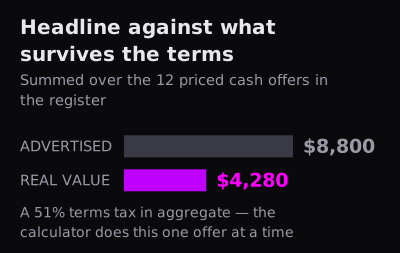
Real Value calculator
Enter the terms of any offer and get what it is worth, its Terms Tax, and the deposit at which it stops being a loss.
It calls the same functions that produce every figure in the register, so a number you calculate here and a number in a table can never disagree.
-
Clearing simulator
Simulate a playthrough thousands of times to see how often it gets finished and how often the balance runs out first.
Seeded, so the same inputs always return the same figures. Answers a question about the spread of outcomes, which is deliberately kept out of the value calculation.
-
Code checker
Paste a code you have been offered and see whether it is in the register, what verdict it carries and what it unlocks.
The fastest way to find out that the string someone is selling you belongs to an operator that issues no codes at all.
One engine behind all of it
The arithmetic lives in one module. The register imports it to price its entries, the operator pages import it to compute break-even deposits, and the calculator imports it to answer your inputs. Nothing restates a formula in a second place, which is the only reliable way to stop a published table and a published tool from drifting apart.
The formula itself is set out on the method page, along with the source hierarchy and what happens to an entry that goes stale.
Tools, not a lookup table
A register can only price the offers it has checked, and no register will ever cover every promotion in a market where terms change weekly and operators run state-specific variants. That leaves a permanent gap between what a reader is looking at and what any published table contains.
Tools close that gap in the only honest way available: by handing over the method instead of the answer. If you can read the terms off an operator's page, you can price the offer here, including offers we have never seen and operators we do not track. The alternative would be to guess at figures for promotions we have not checked, which is exactly the practice this site exists to avoid.
It also makes the register falsifiable. Anyone who thinks a figure here is wrong can enter the terms themselves and see whether the arithmetic agrees. That is a stronger claim than asking to be trusted, and it costs nothing to offer when the formula holds up.
Built from templates that already existed
The calculator and the simulator are not written from scratch for this site. They are ports of tested components: a bonus-wagering calculator whose formulas carry their own self-test suite, and a Monte-Carlo engine that proves its own correctness property on every run, with the specific terms this register needs added on top.
That matters for a reason beyond development speed. A calculation written once and tested against known values is more trustworthy than one written fresh for a marketing page, and the simulation engine's self-test asserts the mathematical property that makes the whole value-versus-odds distinction on this site coherent. The tools inherited their credibility rather than claiming it.
Everything runs on your device
There is no server component to any of this. The pages ship the arithmetic and, for the code checker, a small lookup table, and your browser does the rest. Nothing you type is transmitted and no record of a calculation exists anywhere afterwards, including here.
No account, nothing to sign up for
Tools like these are often gated behind an email address, because an email address is worth more to the site than the calculation is to the reader. There is nothing to gate here: no account, no newsletter, no saved history and no login. The page loads, it works, and it forgets everything the moment you close it.
The same applies to the figures themselves. Nothing here is held back for a premium tier and no result is withheld pending a click on an operator link. A site whose argument is that other people obscure things would look ridiculous obscuring its own.
What these tools will not tell you
None of them describes a way to come out ahead of an operator. The house edge is charged in every calculation and every simulated round, exactly as it would be in practice. What they measure is the price of an offer and the shape of its outcomes, which is a different thing from a method, and there is no arrangement of inputs that turns one into the other.
Questions about the tools
Do these tools need an internet connection?
Only to load the page. Once loaded they run entirely on your device, so they keep working offline and nothing you type is transmitted anywhere.
Why do the tools and the register always agree?
Because they call the same module. The arithmetic exists in exactly one place, and every page that needs a figure imports it rather than restating the formula.
Which tool should I start with?
The calculator, if you have a set of terms in front of you. The code checker, if someone has handed you a string. The simulator answers a narrower question and is most useful once you already know what an offer is worth.
Can any of these find me a winning strategy?
No. The house edge is charged in every calculation and every simulated round. These measure the price of an offer and the shape of its outcomes, and no combination of inputs turns either into an edge.
Is the arithmetic published anywhere?
Yes, in full, on the method page, along with the source hierarchy and what happens to an entry that goes stale. A formula readers cannot inspect would not be worth publishing figures from.